




 AAPL Solutions Pvt. Ltd.
Gold
AAPL Solutions Pvt. Ltd.
Gold
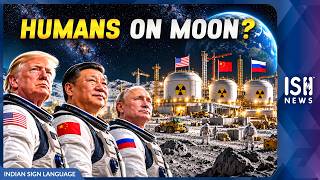
US, China and Russia to Build Nuclear Reactors on Moon
The US, China, and Russia are planning nuclear power systems to support future Moon bases. These reactors could provide continuous electricity, but safety and access to lunar resources - Doubtful.
Why Are the US, China and Russia Planning Nuclear Reactors on the Moon?
The United States, China and Russia are working on plans to build bases on the Moon where humans could live and work. One major challenge is how to provide these bases with a steady supply of electricity. To solve this problem, countries are exploring nuclear reactors that could produce power on the Moon.
The United States is targeting a lunar reactor by 2030. Russia is also planning a lunar power station with a target date of 2036, as part of its cooperation with China. But why is nuclear power important for the Moon?
Why Does the Moon Need Nuclear Power?
A permanent base on the Moon would need electricity to support astronauts, scientific equipment, communication systems and other facilities.
One challenge is the Moon’s long night, which lasts about two Earth weeks. During this time, places without sunlight cannot depend on solar panels alone. Nuclear reactors can produce electricity continuously, regardless of whether sunlight is available. This could make them useful for future lunar bases.
What Is the US Planning?
In January 2026, NASA and the US Department of Energy announced plans to develop a nuclear reactor for the Moon, with a target of deploying a lunar surface reactor by 2030. NASA has also been seeking proposals for technologies needed to establish a Moon base near the lunar south pole.
The reactor project, referred to in recent programme documents as Lunar Reactor 1, aims to develop a system that can operate for five years without needing regular human maintenance.
What Are China and Russia Planning?
China and Russia are working together on the International Lunar Research Station, or ILRS. They began their formal cooperation on the project in 2021. The plan is to build a research station that can support long-term scientific work on and around the Moon.
Russia has announced plans to build a lunar power station by 2036. The project is expected to support the ILRS and provide electricity for lunar equipment, research facilities and other infrastructure. The project is being developed by Russian space and nuclear organisations. However, many technical details of the proposed reactor are still not public.
Why Are Countries Interested in the Moon’s South Pole?
The United States and China are particularly interested in the lunar south pole. Some craters in this region remain permanently in shadow. Scientists believe these areas contain water ice.
If this ice can be collected and processed, it could help provide water for astronauts and potentially produce oxygen and hydrogen for future missions. A permanent base would need reliable power to support these activities. Nuclear energy could therefore become an important part of future lunar exploration.
What Are the Safety Concerns?
Nuclear reactors on the Moon would need careful planning and safety measures.
The reactor would first have to be launched from Earth. If a rocket failed during launch, radioactive material could create risks, depending on the design and condition of the reactor.
Once on the Moon, the reactor would also need shielding and a safe operating area. Astronauts and spacecraft might need to keep a certain distance from it to reduce radiation exposure. This is sometimes called a safety or keep-out zone.
These arrangements could also raise questions about how countries share nearby areas of the Moon.
Has Nuclear Power Been Used in Space Before?
Yes. The Soviet Union launched a satellite called Kosmos 954 in 1977 that carried a nuclear reactor.
In January 1978, the satellite re-entered Earth’s atmosphere and scattered radioactive debris across parts of northern Canada. A joint Canadian-American cleanup operation continued until October 1978.
In 2019, an explosion during a Russian military test involving an isotope power source killed five nuclear agency employees. Some reports linked the accident to work on a nuclear-powered missile, although the exact technology involved was not fully confirmed publicly.
These incidents show why nuclear systems in space require strict safety measures.
What Role Could India Play?
India signed the Artemis Accords in 2023. These agreements set out principles for safe and peaceful civil space exploration. India is also developing its own lunar programme. Chandrayaan-4 is planned as a lunar sample-return mission, while India has set a goal of sending an Indian astronaut to the Moon by 2040.
In August 2026, NASA invited the Indian Space Research Organisation (ISRO) to join its Moon Base programme. The two countries also discussed further cooperation in space science and human spaceflight technology.
What Happens Next?
Nuclear power could help countries support longer missions and build permanent research facilities on the Moon. But the technology will need to meet strict safety and reliability requirements. Countries will also need to work out how lunar facilities can operate safely without unfairly restricting other countries from exploring the same region.
The next space race may not only be about reaching the Moon. It could also be about who can build the infrastructure needed to stay there.