




 AAPL Solutions Pvt. Ltd.
Gold
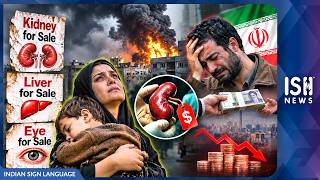
Iranians Selling Their Body Organs Due To Rising Financial Pressure ?
An investigation found more than 600 advertisements offering organs for sale in Iran as financial pressure and poverty affect ordinary families.
Iran’s Economic Crisis: People Advertise Body Organs for Sale
It may sound shocking, but this is happening in Iran. People facing serious financial difficulties are advertising their body organs and tissues for sale.
Earlier, ISH News reported how people in Afghanistan started selling their kidneys and other organs after years of war, unemployment and economic hardship. You can watch our earlier report, Desperate Afghans Sell Kidneys To Feed Families.
Now, similar concerns are emerging in Iran.
The war that began on 28 February 2026 has added to the country's existing economic problems. Rising prices, unemployment and growing living costs have made it difficult for many families to afford basic needs. According to reports, minimum-wage workers in Iran earn around 200 million to 300 million Iranian rials per month, approximately Rs.13,000 to Rs.20,000.
However, independent labour activists estimate that a family of four needs around 1 billion rials per month, approximately Rs.67,000, to cover basic living expenses. This leaves a major gap between what people earn and what they need to survive.
On 8 November, Ali Babai Karamani, chairman of Iran's parliamentary Social Affairs Committee, said around 8 million people were facing absolute poverty and malnutrition. He also said up to 50 million people were struggling to afford basic goods and meet their nutritional needs.
More than 600 advertisements offering body organs for sale
The situation has become so difficult that some people are advertising their body organs and tissues for money. An investigation by Iran International examined more than 600 advertisements posted on a Telegram channel between late May and late October 2026.
The investigation found the following:
| Body part or tissue | Number of advertisements |
| Kidneys | 498 |
| Bone marrow | 279 |
| Liver tissue | 51 |
| Testicles | 15 |
| Corneas | 2 |
The investigation found that around one in three advertisements listed multiple organs or tissues.
How are people finding buyers?
One of the main platforms being used is Telegram. People post advertisements with details such as their age, blood group, the body part they are offering, the amount they expect and their contact number. Interested buyers can then contact them directly.
In Tehran, a street called Farhang Hosseini Street is popularly known as Kidney Street. Advertisements from people looking for buyers cover walls, metal doors and buildings in the area. Some Telegram channel operators are also reportedly charging people to publish these advertisements.
One channel asked for 2 million Iranian rials to publish an advertisement. For another 4 million rials, the operator offered to share the seller's details with people connected to patients waiting for organ transplants. This means people could be asked to pay 6 million rials before even finding a potential buyer.
However, these advertisements do not prove that a sale or transplant has taken place.
Is organ selling legal in Iran?
Iran has a government-regulated system that allows financial compensation for living kidney donors. The programme began in 1988 to address the shortage of kidneys available for patients needing transplants. However, this system does not mean that selling every body part advertised online is legal or medically possible.
For example, a kidney or part of the liver can be donated by a living person under medical supervision. Bone marrow donation involves collecting blood-forming cells. Corneas are generally obtained from deceased donors, and there is no established procedure in Iran for transplanting testicles from living sellers.
The latest reports highlight a worrying side of the country's economic crisis.
People struggling to afford food, housing and other basic needs are considering putting their health at risk to earn money. And this is not the first time such desperate choices have been reported. The crisis in Afghanistan showed how years of conflict and economic hardship can push families towards selling their organs.
Now, reports from Iran are raising similar concerns. War does not only damage buildings and economies. Its effects can also reach ordinary families, forcing people into difficult decisions that may affect their health and future.
Even when a war ends, its impact on people's lives can continue for years.