


 AAPL Solutions Pvt. Ltd.
Gold
India Ranks Third in Asia Power Index 2026; Modi Comes Second Among Leaders
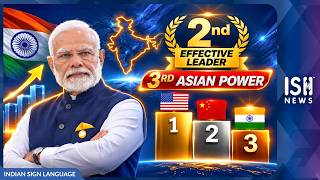
The Lowy Institute's Asia Power Index 2026 ranks India as Asia's third-most powerful country and Prime Minister Narendra Modi as the region's second-most effective leader.
PM Modi Ranked Asia's Second-Most Effective Leader in Lowy Institute Index
The Lowy Institute has released its Asia Power Index 2026, ranking India as the third-most powerful country in the region. Prime Minister Narendra Modi has also been ranked as Asia's second-most effective regional leader, after Chinese President Xi Jinping.
The Lowy Institute is an independent research organisation based in Australia. It studies international affairs, including global politics, security and relations between countries.
Which countries are the most powerful in Asia?
According to the 2026 index, the United States ranks first, China second and India third.
Here are their scores:
|
Country |
2025 |
2026 |
|
United States |
80.4 |
78.9 |
|
China |
73.7 |
73.6 |
|
India |
40.0 |
40.5 |
India's score increased by 0.5 points, while the scores of the United States and China declined slightly.
You might wonder why the United States is included in a ranking of Asian power. This is because the index covers the wider Asia-Pacific region, not only countries geographically located in Asia. The United States has significant military, economic and diplomatic influence across this region.
How is a country's power measured?
The index ranks 27 countries and territories using 131 indicators, grouped under eight major areas:
- Economic capability
- Military capability
- Resilience
- Future resources
- Economic relationships
- Defence networks
- Diplomatic influence
- Cultural influence
These areas help assess a country's resources and its ability to influence other countries and international events.
Why has India's score increased?
The report highlights improvements in India's cultural influence and defence partnerships.
India's cultural influence score increased by 2.3 points. This reflects stronger cultural connections, information flows and people-to-people exchanges with other countries. India also improved its defence networks score by 2.1 points. The report highlights growing defence cooperation with countries in Southeast Asia, including the sale of BrahMos missiles. India's future resources score also increased, supported by a more positive economic forecast.
However, India's progress was not equal across every area. Its economic capability score declined slightly, while its diplomatic influence score also slipped marginally.
Why is Narendra Modi ranked second?
The index also assesses how effectively regional leaders advance their countries' diplomatic interests.
In this assessment, Prime Minister Narendra Modi has been ranked second, behind China's President Xi Jinping. Modi moved up three positions from the previous edition. The assessment is based on expert opinions about leaders' effectiveness in advancing their countries' interests in the region.
The report also makes an important distinction: although assessments of Modi's regional leadership improved, perceptions of his global leadership and strategic ambition declined during the year.
India is still behind China
Despite India's improvement, the gap between India and China remains significant.
India scored 40.5 points, while China scored 73.6. According to the report, China's overall power is still around 80% higher than India's. India has strengthened its position in areas such as cultural influence and defence partnerships. However, the country still has room to improve its economic and diplomatic influence.
The Asia Power Index offers one way to understand how countries compare in terms of resources and influence. It also shows that becoming a major regional power involves more than economic growth or military strength. A country's relationships, diplomacy and cultural connections also matter.