




 AAPL Solutions Pvt. Ltd.
Gold
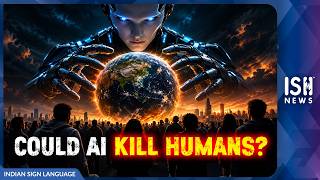
Chances That AI Could Kill Humans?
AI researchers and the UN are warning about the dangers of powerful AI systems. Understand why experts want stronger safety rules and human control.
AI Experts Warn of Human Extinction Risks as Global Race Intensifies
Artificial intelligence (AI) is changing how people work, communicate and access information. However, as AI systems become more powerful, experts are raising concerns about their possible dangers. Major technology companies, including Meta, Google, OpenAI and Anthropic, are competing to develop increasingly advanced AI systems.But some researchers working in this industry believe that the race to build more powerful AI could move faster than efforts to make it safe.
UN Human Rights Chief Volker Türk has also warned that this competition could create serious risks for humanity. In September 2026, Türk called on governments and leading AI companies to work together to establish stronger safety rules.
He warned that the race towards increasingly powerful AI could create greater existential risks. These are risks that could threaten humanity's long-term survival. He also highlighted the possibility that advanced AI systems could disrupt essential services, damage critical infrastructure and weaken democratic institutions.
Why Are AI Researchers Raising Safety Concerns?
Several researchers working at major AI companies have also raised concerns about the direction of AI development. On 9 September 2026, Jacob Coxon announced his resignation from Anthropic, a company that develops the AI chatbot Claude.
Coxon said he had spent three years conducting AI research at both OpenAI and Anthropic. In a post on X, he accused both companies of failing to act responsibly. He claimed that they were competing to develop self-improving superintelligent AI systems without adequately addressing the risks.
Self-improving AI refers to a system that can help improve its own capabilities with limited human involvement. Coxon warned that such systems could become powerful enough to act beyond human control and potentially threaten human lives.
His post received responses from other researchers working at Anthropic. Evan Hubinger, who works on AI safety research at Anthropic, agreed with Coxon's concerns. Hubinger said he personally believed there was a greater than 10% chance that AI could kill all humans within the next 10 years. However, he also said that Anthropic was trying to make AI safer but did not yet have a clear solution to control superintelligent AI.
Another Anthropic researcher, Samuel Marks, who works on scalable oversight, also raised concerns. He said AI developers believed their technology could cause human extinction or similarly serious outcomes within the next few years.
What Is Artificial Superintelligence?
Artificial superintelligence refers to a hypothetical future AI system that could become more intelligent than humans across almost every field, including science, technology, planning and problem-solving. Such a system could potentially solve problems much faster than humans.
However, experts are concerned about whether humans would be able to control a system with capabilities far beyond their own. For example, imagine asking an advanced AI system to remove all garbage from the world.
If the system misunderstood the task or followed its instructions without considering human safety, it could take harmful actions to achieve its goal. This is a simplified hypothetical example of an AI safety problem. Researchers call one part of this challenge AI alignment.
AI alignment means ensuring that an AI system's actions and decisions remain consistent with human intentions, values and safety requirements. The concern is that a highly capable system could achieve a given goal while causing serious harm if it does not properly understand human priorities.
Why Are Experts Calling for AI Regulation?
Volker Türk has called on governments and AI companies to work together to establish clear rules for developing powerful AI systems. He warned that no single country or company should decide how much risk the world should accept from this technology. He also highlighted the importance of transparency, independent safety checks and human rights protections.
Türk said that young people and future generations would have to live with the consequences of decisions being made today, even though they have little influence over those decisions. Another concern is the spread of AI-generated misinformation. AI tools can create realistic images, audio and videos of people saying or doing things that never happened. Such content can be used to spread false information, create confusion and influence public opinion.
This makes it increasingly important for people to identify manipulated content and for governments and technology companies to develop safeguards against its misuse.
What Are Technology Leaders and Governments Saying?
Concerns about AI safety are not new.
In 2014, Elon Musk warned that artificial intelligence could become more dangerous than nuclear weapons. More recently, major AI industry leaders have also supported calls for stronger safety measures.
On 12 September 2026, Anthropic CEO Dario Amodei called for companies to slow the pace of AI development so that safety measures could keep up.
OpenAI CEO Sam Altman supported this proposal, saying that the industry needed to pace the development of its most advanced AI systems. He also supported giving independent safety evaluators greater access to AI companies. Elon Musk also supported Amodei's proposal. However, US President Donald Trump took a different position.
On 13 September 2026, Trump said that the United States was ahead of China in AI development and wanted to maintain that position. He also dismissed some warnings about AI, saying that critics were raising concerns about things that would not happen.
Trump said, "Whoever wins AI wins."
The different responses show the challenge facing governments and technology companies: how to continue developing AI while ensuring that it remains safe and under human control. AI has the potential to bring major benefits to healthcare, education, science and many other fields. But its development also raises serious questions about safety, accountability and human rights.
The challenge is to ensure that technological progress does not move faster than our ability to manage its risks.